Dictation Practice: The Boring Exercise That Fixes Your Listening Faster Than Anything Else
Ask a translator or a court interpreter how they built their ear, and a surprising number will say the same unsexy word: dictation. Write down what you hear, word for word. It’s slow, it’s humbling, and it compresses months of vague “immersion” into weeks of precise signal.
Here’s why it works, and a 10-minute protocol you can run daily.
Why dictation beats just listening
Listening comprehension has two failure modes, and passive listening can’t tell them apart:
- You didn’t know the word (vocabulary gap)
- You couldn’t hear a word you know (decoding gap)
The second one is the silent killer of intermediate learners. You know “a lot of,” but in fast speech it arrives as “alotta” and your comprehension flickers. Vague listening never isolates these failures — everything just sounds “fast.”
Dictation forces each failure to identify itself. You can’t write what you didn’t decode, and the blank on your page is a precise, addressable unit of ignorance.
The 10-minute protocol
Material: 30–60 seconds of audio at or slightly above your level, with an accurate transcript.
- Dictate (4 min). Play one sentence, pause, write what you heard. Replay up to three times per sentence, then move on. No dictionary yet — spell unknown words phonetically and keep going.
- Check (3 min). Compare against the transcript. Mark every gap, but sort the marks into three buckets:
- V: didn’t know the word
- D: knew the word, couldn’t decode the sound
- S: heard it right, spelled/structured it wrong
- Repair (2 min). For each D: replay that fragment five times, listening for exactly where the sounds glue together. For each V: look it up once. For each S: say the sentence aloud once.
- Relisten (1 min). Play the whole clip once more at normal speed. It should now sound slower — not because the audio changed, but because your decoding did. This final listen is the payoff; don’t skip it.
What your mistakes tell you
The bucket ratio is a diagnostic. Run this for a week and count:
- Mostly V → your level is below your material. Drop down a difficulty; dictation isn’t a vocabulary tool.
- Mostly D → perfect fit. This gap closes fast with daily work — often visibly within two weeks.
- Mostly S → your ear is fine; your production is ahead of your spelling/grammar attention. Shift time to reading and writing.
Most intermediate learners are shocked to find they’re 70% D. All that “the audio is too fast” is really “I can’t hear the words I already know” — which is fantastic news, because decoding is the most trainable of the three.
The friction tax (and how to remove it)
Classic dictation is done with a keyboard, an audio player, and a transcript in another window. The sentence-by-sentence pause-replay-check loop is where sessions die: scrubbing to the start of a sentence ten times burns more patience than the dictation itself.
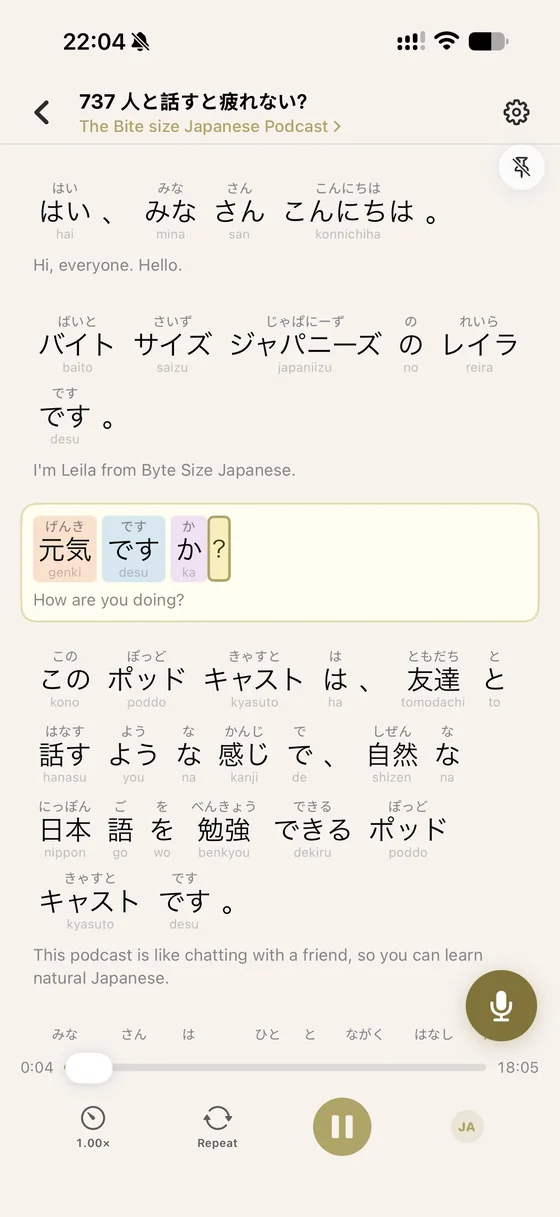
If you’re using Chorus, the loop is already built: sentences are the unit of the player (tap to replay one, no scrubbing), the word-level transcript doubles as the answer key, and the check step happens in place — tap the word you missed and see it. The repair step’s “replay the fragment five times” is a single tap on the word. The whole flow is here — but the protocol above works with any player and transcript if you have the patience for the scrubbing.
One warning
Dictation on material that’s too hard is just pain with no signal. If you’re leaving more than half the sentences blank after three replays, the material is wrong, not you. Drop the difficulty until the blanks are scattered — one or two per sentence — and work from there.
Try this method with Chorus
Chorus turns any podcast, video, or song into a lesson: word-level subtitles you can tap, instant AI explanations of any sentence, and Echo practice that plays one sentence at a time.
See how Chorus works →