
How to Practice Shadowing: A Step-by-Step Method That Actually Works
Shadowing — repeating a native speaker’s audio a half-beat behind them — has a reputation problem. People try it once, mumble along to a podcast at full speed, understand nothing, and conclude it doesn’t work.
The method isn’t broken. The progression is. Most people start at step 5 of an 8-step ladder and then wonder why they fall off. This article gives you the whole ladder, with a checkpoint at each rung so you know exactly when to climb.
What shadowing actually trains
Before the steps, one honest sentence: shadowing does not primarily train listening comprehension. It trains the motor side of the language — rhythm, stress, connected speech, and the speed at which you can produce sounds. The listening gains are real but secondary: you start hearing the language the way your mouth has learned to say it.
That’s why shadowing pairs so well with intensive listening. Listen first to understand; shadow afterward to own it.
The progression
Step 1: Listen once, cold
No transcript, no subtitles. Just listen to 30–60 seconds of audio and note what you catch. You’re not testing yourself — you’re marking the territory.
Step 2: Read the transcript and resolve every unknown
Now read. Look up words. Mark the links: want to → wanna, did you → didja. This is where comprehension happens, and skipping it is the #1 reason shadowing “doesn’t work.”
Step 3: Listen again with the transcript
Same 30–60 seconds, eyes on the text. Everything you resolved in step 2 should now be audible. If it isn’t, listen again. This step rewires your ear.
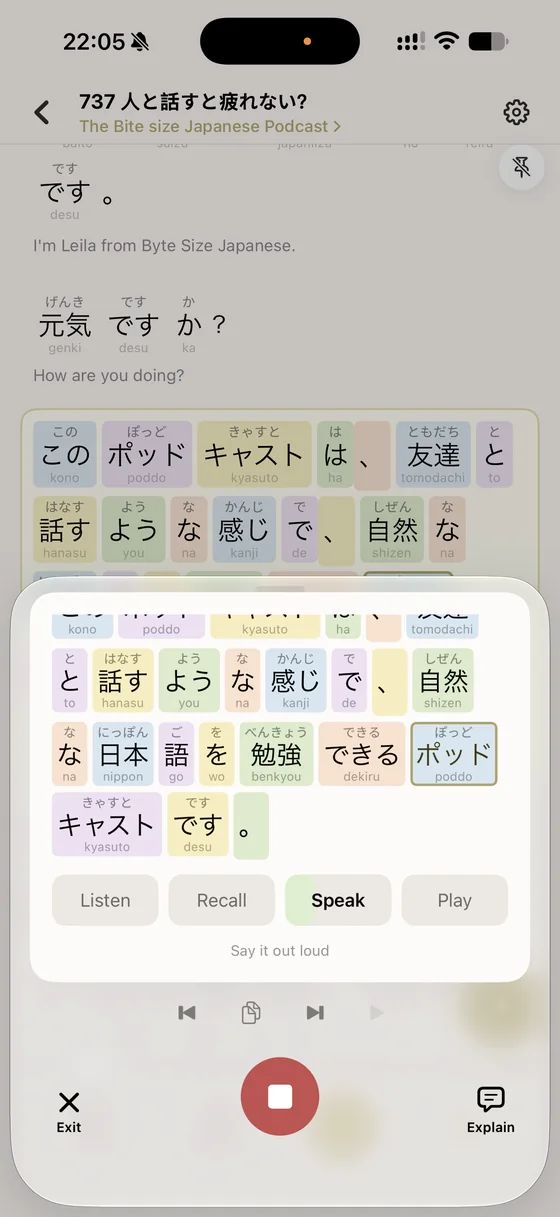
Step 4: Echo — one sentence at a time
Play one sentence, pause, repeat it out loud from memory. Not simultaneous yet. Just echo. If you can’t remember the sentence, it’s too long — echo half of it.
Checkpoint: you can echo every sentence in the clip without reading. Move on only after this.
Step 5: Shadow while reading
Now speak along with the audio, reading the transcript. You’re allowed to lag a few words behind. The goal here is rhythm, not memory — match the melody and stress, not the exact words.
Step 6: Shadow without the transcript
Same thing, eyes closed. You will drift and invent words. That’s fine; drift is information. When you drift badly, stop, re-check that sentence in the transcript, and resume.
Checkpoint: you can shadow 30 seconds of audio without the text, losing no more than a phrase or two.
Step 7: Full-speed overlap
Shadow simultaneously from the start, no lag, no text. This is the version you saw on YouTube. It only feels good after step 6 — which is why starting here fails.
Step 8: Record and compare
Shadow once while recording yourself. Play your recording against the original. Pick one thing to fix — a vowel, a linking, a stressed syllable — and shadow that sentence five more times. One fix per session. That’s the whole trick to improving instead of just repeating.
How much and how often
- Duration: 10–15 minutes a day beats an hour on Sunday. Your mouth is a muscle group; it fatigues fast.
- Material: 30–60 second clips. A single podcast minute is a full session at first.
- Difficulty: you should understand ~80% after step 2. If it’s 100%, it’s too easy for shadowing (fine for warm-up). If it’s 50%, the ear work will drown the mouth work.
The one tool that changes the economics
The painful part of shadowing was never the speaking — it was the logistics: scrubbing audio to a sentence, checking a word, replaying the same three seconds eleven times. That friction is why most people quit in week one.
This is exactly the workflow Chorus is built around: word-level subtitles so you can tap any word mid-sentence, a pause-after-every-sentence mode for the echo step (steps 4–6), and AI explanation of the sentence you’re stuck on — without leaving the audio. See how Chorus works, then try the progression above on a 60-second podcast clip.
A note on honesty
Shadowing will not make you fluent in a month, and anyone selling that is selling something. What it will do, reliably, in 2–3 weeks of daily practice: your mouth stops tripping over common phrases, and sentences that used to blur into noise start arriving as words. That second effect is the one that keeps people hooked.
Try this method with Chorus
Chorus turns any podcast, video, or song into a lesson: word-level subtitles you can tap, instant AI explanations of any sentence, and Echo practice that plays one sentence at a time.
See how Chorus works →