
Learning a Language with Podcasts: How to Stop Wasting Your Listening Time
Podcasts are the most recommended — and most wasted — resource in language learning. The recommendation is right; the usage is wrong. Here’s the difference, and a way to fix it with audio you’re probably already subscribed to.
The background trap
You press play on your commute, the language washes over you, some of it sticks. A month later you can follow the easy episodes and still miss half of the hard ones. This is passive exposure: it maintains comfort, builds almost nothing.
The reason is mechanical. Comprehensible input — the stuff that actually drives acquisition — has to be comprehensible. Audio that streams past unprocessed is not input; it’s weather. Your brain needs a moment to resolve each sentence: hear it, segment the words, connect meaning. Background listening denies it that moment.
What turns a podcast into a lesson
The fix is not a better podcast. It’s a different relationship with the same audio. A real listening session has four moves:
1. Pick one minute, not one episode
The unit of listening practice is the minute, not the episode. One minute of hard audio, processed fully, beats twenty minutes of half-followed audio. This feels slow. It isn’t — it’s the only mode where hard material becomes easy material.
2. Listen once raw, once with support
First pass: no text, catch what you catch. Second pass: with a transcript or subtitles, resolve every word that blurred. The gap between pass one and pass two is the training. That gap is where your ear grows.
3. Interrogate one sentence
Pick the sentence that resisted you most. Look up the words. Notice why it was hard — a linking? an unknown word? a grammar pattern you half-know? One sentence interrogated deeply teaches more than ten heard loosely.
4. Say it back
Read it aloud, or better, echo it after the speaker. Production forces the sentence through a different channel and makes it stick. This is the step everyone skips and the reason sessions don’t compound.
Choosing material by the 80% rule
Your audio should hit a specific target: after reading the transcript, you should understand about 80–90%. Before the transcript, 40–70% is fine.
- Comprehension below 40% even with a transcript → too hard, drop a level
- Comprehension at 100% without a transcript → too easy for study; great for enjoyment, zero for growth
Learner-graded podcasts are built for this, but the honest truth is that real podcasts made for native speakers are both more interesting and more durable — you just need the tooling to survive them at first.
The friction problem
Every point above fails at the same place: logistics. Native-speed podcasts don’t come with transcripts you can tap. Pausing at every sentence on a phone player means scrubbing, replaying, switching to a dictionary app, losing your place. Ten minutes of study becomes four minutes of study and six minutes of app-switching.
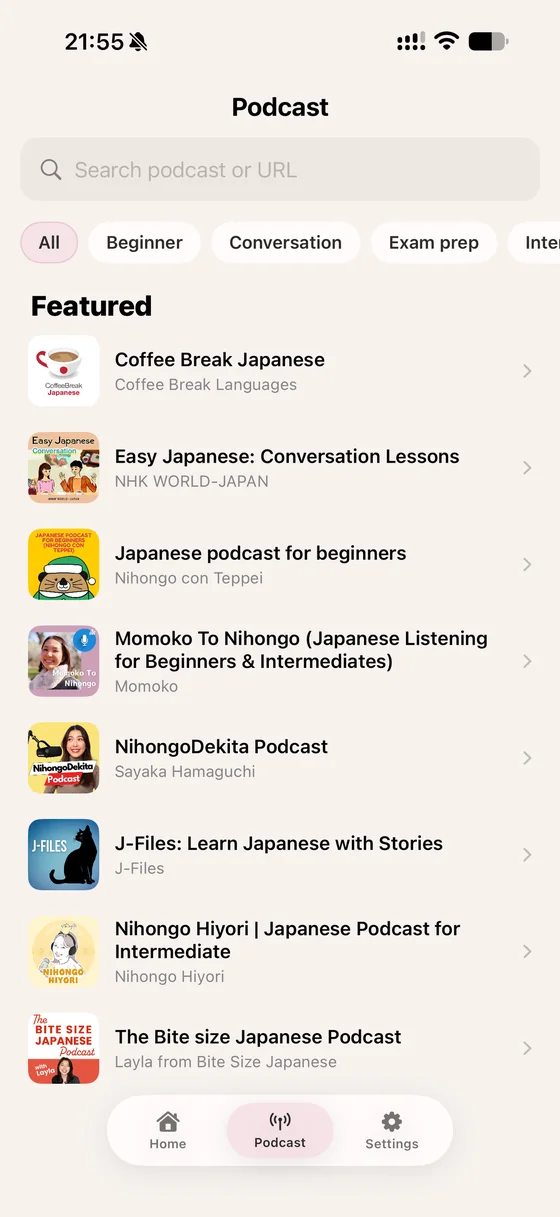
This friction is the reason Chorus exists. You pick a podcast feed or import audio, and every episode arrives with word-level subtitles — tap any word to see it isolated, replay one sentence without hunting for it, and ask AI to explain the grammar of the sentence you’re stuck on, in place. The workflow above — one minute, two passes, one interrogation, one echo — becomes something you can actually do on a train. Here’s the short version of how it works.
A realistic schedule
If you have 15 minutes a day:
- 10 minutes: one podcast minute, processed with the four moves
- 5 minutes: echo practice on the sentences you interrogated
Do that for a month and the episodes that were “hard” move into the “easy” column. That migration — not the number of hours logged — is the only metric that matters in listening practice.
Try this method with Chorus
Chorus turns any podcast, video, or song into a lesson: word-level subtitles you can tap, instant AI explanations of any sentence, and Echo practice that plays one sentence at a time.
See how Chorus works →